Tuesday, April 14, 2015

Static Electricity Investigation

Focus Question: What happens when we rub a plastic spoon on cloth and hold it closely to the salt and pepper?

Prediction/Hypothesis: If we use static electricity, then we can separate the salt and pepper.

Planning: Salt, pepper, plastic spoons, Tupperware bowls, Ziploc bags, carpet

Data:
Materials
What Happened
Salt (1 tbsp.)
Pepper (1 tbsp.)
Bowl
Plastic spoon
Carpet
After mixing the salt and pepper together, as well as rubbing the spoon on the carpet for about 20 seconds and holding it to the S&P mixture, the pepper began to stick to the spoon. Some salt stuck as well but not very much, depending on how close you held the spoon.

Claims & Evidence: If we have salt and pepper mixed together, then we can use a plastic spoon rubbed against cloth to separate the two variables.

Conclusion: What happened when you rubbed the spoon on the carpet and held it over the salt and pepper mixture? What caused the S&P to stick to the spoon? We learned that static electricity is made up of positive and negatively charged particles. The particles attract to each other and we observed this while watching the salt and pepper stick to the spoon.

Questions: Is there any other items we could use to demonstrate static electricity? What else could we rub the spoon on the get the same reaction with the salt and pepper?

Physical Science (chemical change (balloon/vinegar/baking soda investigation)

Focus Question:  How can you create a chemical change?

Prediction/ Hypothesis: If we combine vinegar and baking soda, then the two will begin to fizz.

Planning: Baking soda (1 tbsp. in each balloon), vinegar (1/4 cup in each bottle), water bottles, balloons

- Each student will be given a balloon and a bottle. In the bottle there will be vinegar and in the balloon there will be baking soda. When you get your materials, place your balloon opening over your water bottle opening. Carefully pick up your balloon and let the baking soda fall into the bottle.

Data:
What We Tried
What Happened
Balloon filled with baking soda (1 tbsp.)
Vinegar (1/4 cup) in the bottom of the bottle
Putting the filled balloon on the bottle
The balloon immediately began to inflate. The vinegar and baking soda combining made lots of white fizz that slowly turned into a milky liquid. Balloon slowly began to deflate after a few minutes.

Claims & Evidence: We claim that when you combine a solid and a liquid, a chemical reaction can occur. This was evident when we added vinegar to the baking soda and a gas was formed.

Conclusion: Why did the balloon inflate? We combined our baking soda (solid) and vinegar (liquid) and that made a gas. The gas inflated the balloon. In this investigation could we take this gas and break it apart to make vinegar and baking soda again?

Questions: Do you think the amount of vinegar and baking soda had to do with the balloon filling up with gas? What other substances can you put together to make a gas?


Earth Science (Sunscreen experiment)

Focus Question: Why do we wear sunscreen?

Prediction/ Hypothesis: I think the sunscreen with the higher SPF will show as more protective for our skin because the number on the bottle is higher.

Planning:
  • 1 Sheet of 81/2” x 11 clear plastic acetate (at local office supply stores)
    Black permanent marker
    Three “protection levels” of sunscreen SPF 8, 15 and 45.
    Photoreactive paper
    Plain cookie sheet
    9x13 Pyrex dish of water
  • 1.)   Explain to students that they will be looking at what is really happening when they smooth sunscreen onto their skin.
    2.)   Take the clear plastic sheet. Draw a straight line vertically and horizontally through the middle of the sheet making four different “panes”. Mark one SPF 0, another SPF 8, then SPF 15, and finally SPF 45.
    3.)   Measure about ¼ teaspoon of each kind of lotion and use your finger to smooth it carefully over its appropriate “pane” on your plastic. (Remember one pane will have no sunscreen at all).
    4.)   Quickly remove four pieces of photoreactive paper from their protective envelope, place them on the cookie sheet, and then cover them immediately with the plastic sheet you just prepared.
    5.)   Place the cookie sheet in full sun, with no parts shaded, and leave it there for 1-4 minutes, or until the SPF 0 pane looks nearly white.
    6.)   Bring sheets inside, and carefully take the plastic sheets off. Then rinse the papers in the water tray and remove to observe. 
Data: 
Predictions
Results
SPF 0
There will be no protection because there is no sunscreen.
This one had the most exposure to the sun. It turned white as the sun hit it.
SPF 8
This one will be the least protective besides no sunscreen.
This one looked white, but it looked like water. It might not protect us for as long because it looks thin.
SPF 15
This will be the second best sunscreen to protect our skin.
This one was the whitest. It looked thicker than the others and had less blue coloring showing through the sunscreen.
SPF 45
This will be the best protection for our skin.
This one showed the color blue all over and less white.


Claims & Evidence: We claim that SPF 15 had the most protection from the UV rays because it had the most white left underneath on the photoreactive paper.

Conclusion: We learned that the higher the SPF does not mean the more protection from the sun.

Questions: Do clothes help to protect our skin from the sun? Do animals get sunburned as well?


Earth Science (Difference in dirt investigation)

Focus Question: Is all soil the same? (Yes, No, Maybe) on smartboard


Prediction/ Hypothesis: I predict that all soil is not the same because some feel different from other and are different colors.

Planning: Materials: 4 types of soil, Plastic cups, Aluminum pans, 4 color stickers, Paper divider for dirt, Plastic gloves.

-  Each group will receive 4 cups containing different types of soil with the appropriate color on it and the paper divider. Observe the different types of soil using senses and complete a data chart in science notebooks. Complete data chart as a whole class.

Data: 

Soil TypeWhat do you see?How does it feel?Interesting observations
RedClumpyClumpyIt looks like it might have been found near a river.
BlueBrown/OrangeRocky and mushyIt has roots in it.
GreenGrittyFluffyMaybe found near the shore- sandy
Made a text-to-text to connection to a book.
OrangeDarkestDampNo smell- It looks like it was found in the yard. It looks the most familiar. Found worms in it.

Claims & Evidence: All soil is different because it looks and feels different.

Conclusion: In this investigation we learned that there are many different types of soil depending on where the soil is found. 

Questions: What are the components of soil? What is it actually made of? 

Monday, April 13, 2015

Gravity (Egg) investigation

*First read a book- "Why Can't I Jump Very High", "Gravity's a Mystery", "I Fall Down"

Focus Question: Why do we come back down to the ground when we jump in the air? How does Gravity work on an object?

Prediction/Hypothesis: I think using the cotton balls, sponges and felt to wrap the egg will keep it from breaking because they will act as a cushion on impact.

Planning: Hard boiled eggs, string, felt, cotton balls, aluminum foil, pieces of sponge, paper plates, hole puncher, scissors
*Our group used 2 pieces of sponge, 2 pipe cleaners, 3 pieces of felt, 1 paper plate, 2 cotton balls, 3 pieces of string.

Data:

What We Tried
What Happened
Support cushion, parachute
Egg cracked, although it slowed down the fall
Equal support with sponges, cotton balls, felt and aluminum foil around the egg
Egg cracked
Resistance with paper plate used as a shield
Eggs cracked, didn't resist air well


Claims & Evidence: After much trial and error, we decided that if you could slow the egg's fall then it wouldn't crack. The parachute is what we used to help slow the egg down.

Conclusion: In this investigation we learned that the egg needed to be slowed down while falling to keep from breaking. We achieved this by building a parachute to slow its fall.

Questions: Do real life parachutes work in the same way? Does gravity pull on parachutes?

Building Bridges

Focus Question: How are bridges supported to hold weight?
-Have students share their past experiences with bridges.
-Have students share other questions they might have about bridges.
* Use their questions to start discussion
-Think about how you can test your questions. What type of investigation can we use to model and test your question?

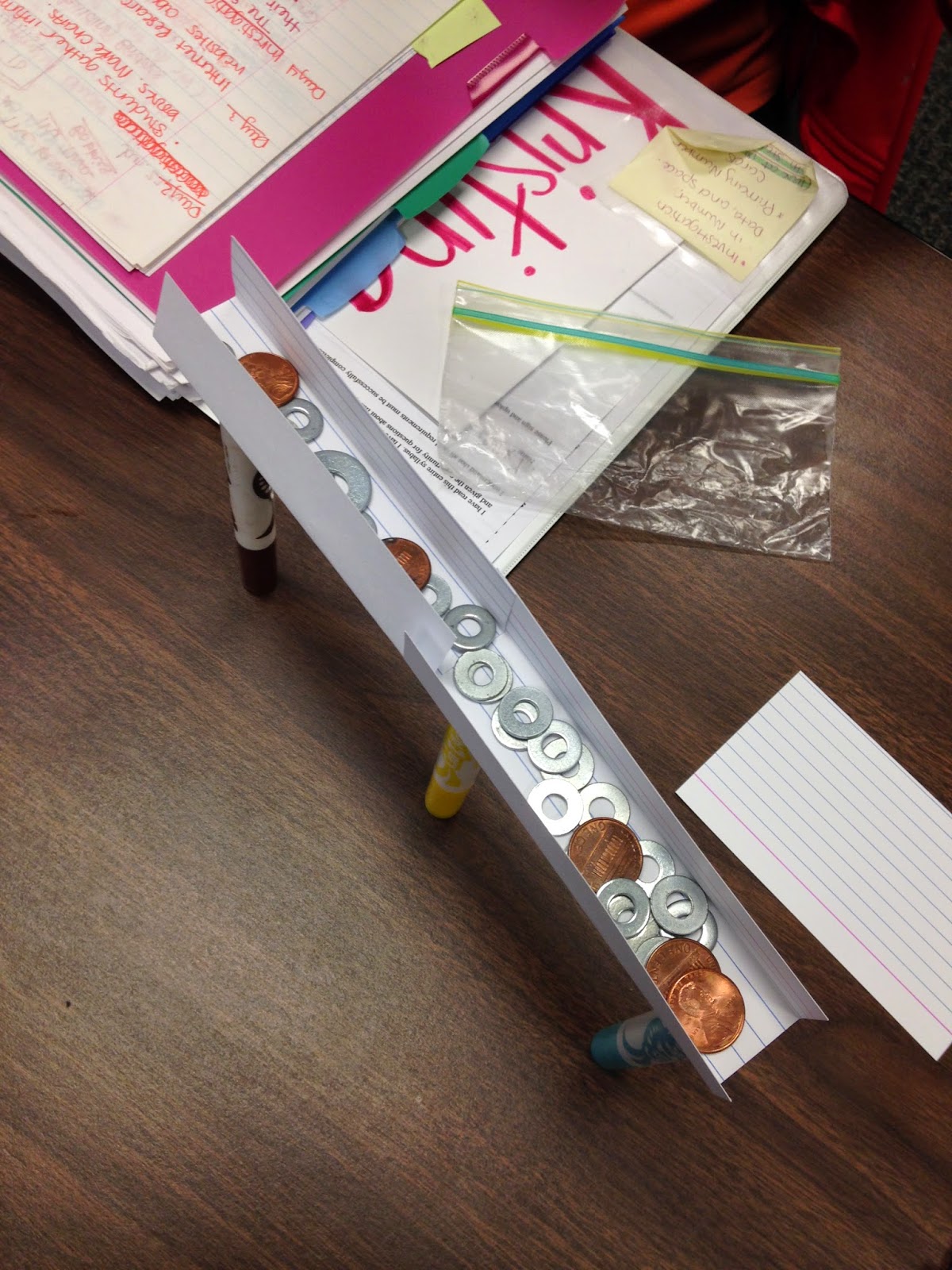
Prediction/ Hypothesis: If the markers are closer together, then the bridge can hold more washers and pennies. 

Planning: index cards, markers, multiple size washers, pennies, Ziploc bags
-Use the markers as the support for the bridge, the index cards will be the actual bridge. Use the pennies/washers to test the sturdiness of the bridge and see how much it will hold. 

Data:


Claims & Evidence: We learned that the lower the bridge is, the more stable it is. We also discovered the shorter the bridge was, the more the support needed to be spread out and a taller bridge would need more support. 

Conclusion: So in this investigation, we learned that bridges need equal supports to hold weight. We also learned that if the markers (support) are closer together that the index cards (bridge), will be able to hold more weight (washers & pennies). 


Paper Helicopters

(Background info. for this lesson- The shape of the rotor blades makes it spin when dropped fro a height. Gravity pulls the helicopter down. The air resists the movement and pushes up each rotor separately, causing the helicopter to spin.

Focus Question: What causes a helicopter to stay in motion and deflect gravity (spinning)? 

-Has anyone ever flown in a helicopter, what does it feel like? If students have never been in one, read a book or find a short video to show the class.

Prediction/Hypothesis: If  I make the blades thicker, this will cause the helicopter to stay in the air longer and pin more. 

Planning: scissors, paper, pencil, paper clips

Data: Make a model in front of the class before students begin to build on their own.


What worked
What didn't work
The thicker the paper, the more successful.
Letting it fall from a higher elevation.
Having thick blades made them floppy
Trimming the blades to make them thinner.
Flick my wrist when dropping the helicopter.
Having the paper clips on the bottom.
Putting two paper clips on the side made t work better than two on the bottom.


Claims and Evidence: If we change the size of the blades (variable) the air will circulate better. 

Conclusion: So in this investigation we were able to explore how some things fall and how varying the size of the rotor blades, the shape of the rotor blades and the weight of a paper helicopter affect the way a helicopter spins. 

Questions: What did you notice about the spins for each helicopter? Did they spin clockwise or counterclockwise? Why? How can you change the spin? Does the weight (number of paper clips on the stem) change the spin? Which combination made the best spinning helicopter?